
The Basic Facts
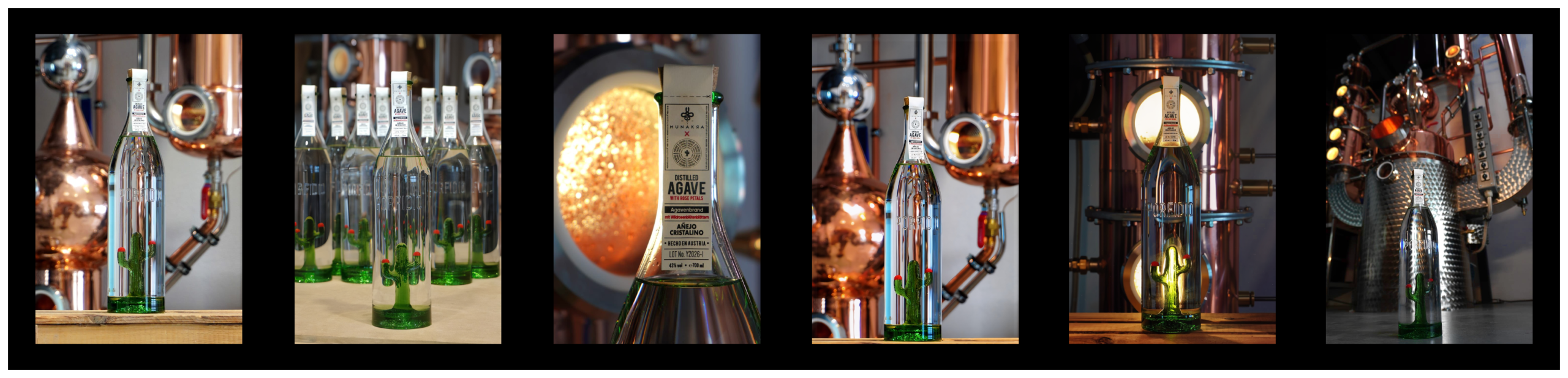
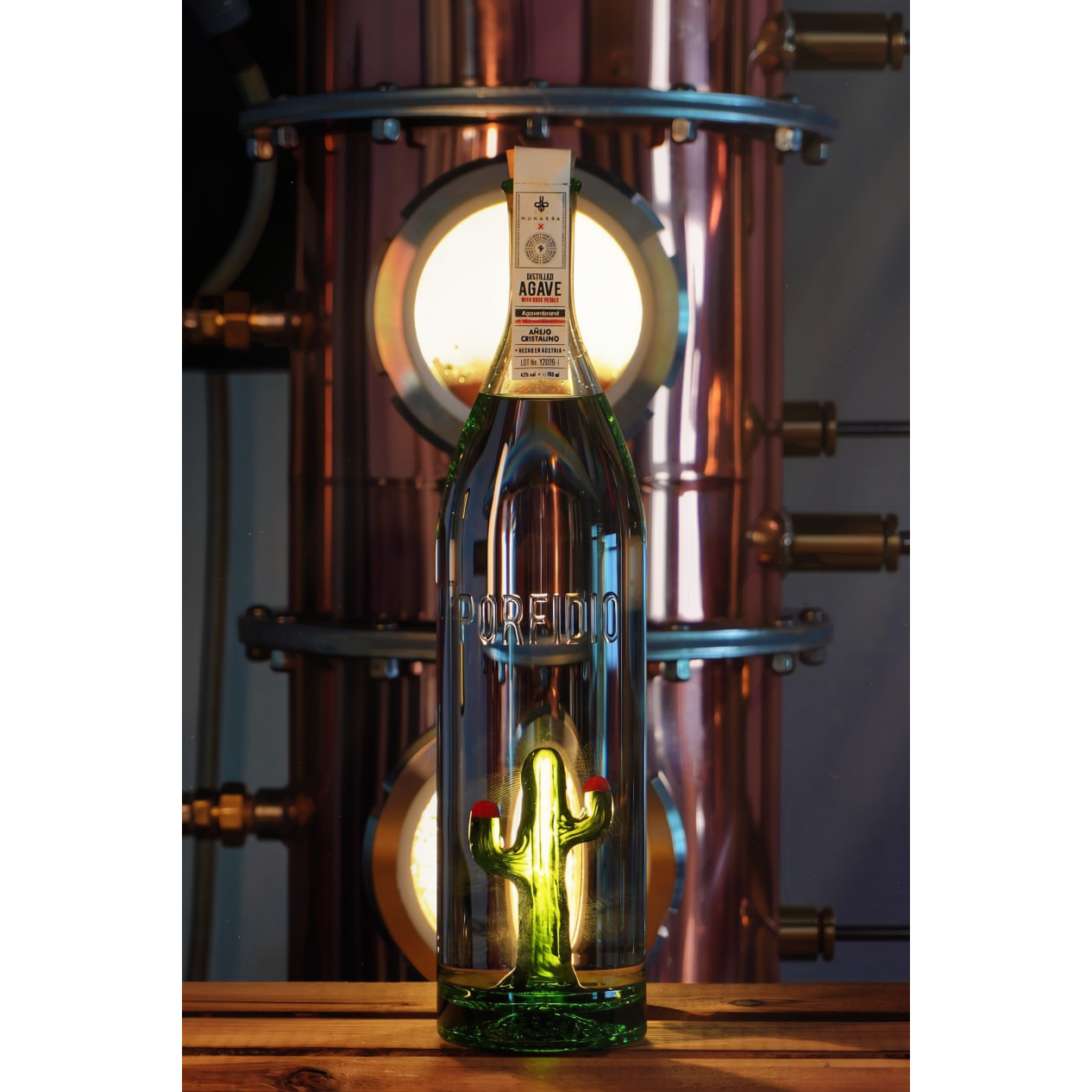
Porfidio Añejo Cristalino embodies its title perfectly, being—self-evidently—an Añejo Cristalino!
Defined by their pristine appearance, Cristalinos are cask-aged agave spirits gently stripped of their color while retaining their mature character.
Acquired during the cask-aging process, the amber tint may be removed either by the economical method of activated charcoal filtration or through the premium approach of a single re-distillation. Re-distillation is highly prized over activated carbon filtration for Cristalinos because it refines the spirit without stripping away its natural complexity. While carbon filtering is cheaper, it uses absorption to strip out color, tannins, and flavors in one go, often resulting in a neutral liquid that requires additives to restore flavor.
From a quantitative standpoint, redistillation inherently incurs a loss of approximately 25% of the total alcohol volume. Conversely, activated carbon filtration limits volume depletion to a maximum of 3%. Consequently, the net differential in production costs between these two Cristalino methodologies amounts to 22%.
Legally, Cristalinos are officially categorized by their base spirit as either Reposado Cristalinos and & Añejo Cristalinos. The Añejo Cristalino variety, having matured extensively in wood casks prior to its color removal, is regarded as the superior expression, yielding a profile that is notably more refined and exceptionally smooth.
Porfidio’s Cristalino falls under the distinguished Añejo Cristalino classification. It’s exceptional character is rooted in its origin; before re-distillation, the foundational spirit is Porfidio’s thirty-year-old Añejo Extra from the 1996 vintage.
What has been stated so far consists merely of validated science and a modicum of legal formality. Turning the page now over to subjective perceptions, while purpose theoretically underpins most human endeavors, the explicit aim of crafting Cristalino is to deliver a smoother, refined white agave spirit. Critics dismiss this objective as completely absurd, yet a new wave of avant-garde connoisseurs champions Cristalino’s flavor as the absolute pinnacle of modern tequila culture. Joining this latest trend in the tequila industry, Porfidio has now also released a Cristalino expression, albeit one defined by a pivotal recipe refinement without parallel.
The singular extravagance of Porfidio’s Añejo Cristalino
For four decades, Porfidio has reigned as the avant-garde of the tequila world, introducing trail-blazing, revolutionary technical innovations once deemed inconceivable. What rivals initially derided as sheer folly has regularly become the very standard they passionately scramble to copy a few years later. Upholding Porfidio’s legacy of unconventional thinking, I proposed a novel method for Porfidio’s Añejo Cristalino: macerating exquisite rose petals within our Extra Añejo before its re-distillation, or conversion, into an Añejo Cristalino. My intent was to forge a highly sophisticated, distinctive aromatic profile, establishing a new benchmark that rises far above today’s luxury Añejo Cristalinos.
However, much like any endeavor that projects an aura of simplicity, a complication lay in wait. For me, it was the daunting reality of over 300 distinct rose species, all with their own distinct, signature aromatic profile, alongside the elusive quest to find the ideal dosage.
This marked the beginning of years of research and experimentation.
Ultimately, I chose the Damask Rose—botanically known as Rosa × damascena and historically native to ancient Persia—drawn by its exquisite and unmatched aromatic profile, which I deemed as uniquely suited for alcoholic maceration. However, creative endeavors are rarely without their complications. For me, the primary obstacle was that Mexico’s floral industry focuses entirely on decorative, chemically-overdosed Floribunda roses. Edible, organic Damask roses are not grown commercially in Mexico because the soil and climate are incompatible.
Driven by this realization, my son Emiliano, a certified horticulturist and expert floriculturist formerly based in Zambia, took up the challenge and set out to track down the world’s premier organic Damask rose cultivators, ultimately tracing the finest yields to the legendary Rose Valley (Rozova Dolina) in Bulgaria and the fertile Isfahan region of Iran.
Regrettably, today Isfahan has come to be more closely associated with Iran’s central nuclear research facilities than with its traditional Damask rose cultivation. Thus, given the current political climate in Iran, venturing there was untenable; and so aligning with one of Bulgaria’s master cultivators of organic Damask blooms became the obvious choice.
Operationally, maintaining freshness always requires a localized geographic approach.
Because Bulgaria is part of Europe, macerating the delicate rose petals in a nearby European Union location, such as Vienna, made perfect logistical sense, successfully avoiding a 7,000-mile flight of roses to Jalisco, Mexico. Thus, rather than transporting Damask roses from Europe to Mexico, I resolved to reverse the journey: I shipped several casks of Porfidio’s Añejo Extra from the town of Amatitan in Mexico’s Tequila Valley to Vienna, placing them in the care of a trusted friend, René Grüner, who owns the Munakra Distillery—a European house highly acclaimed for his mastery of botanical distillation.
There, at his distillery, Porfidio’s Mexican-made Añejo Extra was elevated through an intricate, multi-layered maceration procedure of the Damask rose pedals spanning several weeks, followed by a precise re-distillation in a Kovoděl Janča alembic that stripped away the color while preserving the distillate’s aromatic and agavacious essence.
Ultimately, however, the reality of human endeavors is rarely captured by mere words, which so often ring hollow. It is found instead in the stark, mathematical facts presented herein: a manifesto that some in my field will surely call madness, and others, genius.
And so the curtain rises! Each 700 ml bottle of Porfidio Añejo Cristalino contains the essence of Damask rose petals in the following proportions:
Fact 1: On average, a single corolla of the Damask rose comprises approximately 30 petals.
Fact 2: Upon harvest, 30 fresh Damask rose petals weigh approximately 2 grams.
Following sun-drying to concentrate their rich aroma, this yield is reduced to just 0.18 grams.
Fact 3: Infused into every bottle of Porfidio Añejo Cristalino is the spirit of 377.77 grams of fresh Damask rose petals—the precise equivalent of 34 grams of Damask rose petals gently dried in the Thracian sun.
Fact 4: Because each flower averages 30 petals, 377.77 grams of fresh Damask rose petals corresponds to almost 189 (= 377.77 grams/2 grams = 188.88) intact Damask roses, demanding an active farm footprint of 600 m2 per bottle. Thus, beyond our Agave Tequilana Weber agricultural engagements in Mexico, each bottle of Porfidio Anejo Cristalino also represents a small agricultural commitment to Bulgaria!
Fact 5: At a traditional European florist, a collection of 189 Damask roses commands a commercial value of €756, reflecting a volume-discounted retail price of €4 per individual stem. In Japan, at a discount florist store, a collection of 189 Damasks presently retails at Yen 62,370, or Yen 330 per stem.
In closing, despite my tendency to over-delve into the technicalities—complexities that even the most devoted tequila connoisseurs sometimes prefer to waive—it is my profound hope that you enjoy drinking this exceptional agave spirit as much as our collaborative team at Porfidio x Munakra enjoyed creating it for you!
This limited edition of Porfidio Anejo Cristalino is a rare global offering, with only 300 bottles produced, retailing at an average of $ 850 dollars.





Leave A Comment