
Headquartered in Louisville, Kentucky, Sazerac currently operates more than 500 alcohol brands worldwide. Look inside the company’s history and growth, including newly released statistics.
What do Buffalo Trace, BuzzBallz, SVEDKA, Herbsaint, Peychaud’s Bitters, Myers’s Rum, Goldschlager, and Fireball Cinnamon Whisky have in common? They’re all owned by Sazerac, a privately held spirits conglomerate headquartered in Louisville, Kentucky. Today, Sazerac operates over 500 brands worldwide, ranging from high-end whiskeys to some of the fastest-growing products in ready-to-drink booze. If you enjoy even the occasional American whiskey or classic cocktail, chances are good you’ve had one (or more) of their products—perhaps quite recently.
But as with many family-owned companies, getting a true sense of Sazerac’s scale has been challenging—until now. For this article, the company has revealed new statistics regarding its sales, growth, and employee count, including some numbers exclusive to Forbes. Additionally, both Sazerac’s CEO and CMO have provided quotes on the company’s recent acquisitions and growth strategy.
The numbers themselves tell much of the story. Over $6 billion in annual net sales. More than 8,000 employees worldwide (and over 6,000 in the U.S.). Over $800 million invested in mergers and acquisitions since 2019. More than 525 brands, across 18 distilling and bottling facilities worldwide. And—according to Nielsen data provided by Sazerac—19% U.S. market share by volume.
Of course, Sazerac is still keeping some cards close to its chest. But what follows is a clearer-than-ever look at what makes one of the world’s largest (and still fast growing) alcohol companies tick.
Sazerac’s History
The company’s name finds its origins in 1630s France, where the Sazerac family operated a vineyard and distillery in Cognac. The Sazerac we know today traces its founding to mid-19th century New Orleans, when the Sazerac Coffee House was purchased by Thomas H. Handy. (In modern times, the company still operates a Sazerac House museum, bar, and micro-distillery New Orleans.) In the ensuing decades, the company changed forms several times and became known for distributing its namesake Sazerac cocktail. During Prohibition, the company shifted away from alcohol before reentering the industry post-Repeal. From there, its portfolio grew steadily throughout the rest of the 20th century.
The late 80s, early 90s, and 2000s marked a period of focused expansion for Sazerac, particularly in American whiskey. In 1992, the company purchased what is now Buffalo Trace Distillery. In 2003, Sazerac bought Virginia’s A. Smith Bowman Distillery. And in 2009, Sazerac acquired Barton 1792, a legacy whiskey producer located in Bardstown, Kentucky.
Today, Sazerac is owned by American businessman William Goldring—who serves as Chairman—and his family. The company’s headquarters are in Louisville, Kentucky, an important destination for bourbon and the American spirits industry writ large.
Since Sazerac is a privately held and family-owned company, getting a sense of its size isn’t as simple as looking at quarterly shareholder reports. But the company itself has gradually become more forthcoming with internal stats, including several released in early May 2026. (And some shared exclusively with Forbes by Sazerac’s Global Communications Director.) Below, I’ve shared some of the most illustrative numbers:
Net Sales: $6 billion, based on the last twelve months as of December 2025. (This and several other stats were recently added to Sazerac’s corporate homepage.)
Employee Count: According to data provided by Sazerac, the company employs more than 6,000 people in the United States and another ~2,000 globally.
Facilities: The company operates 18 distilling and bottling facilities worldwide.
Acquisitions: In data provided exclusively to Forbes, Sazerac revealed it has acquired more than 215 drinks brands since 1989. It has invested over $800 million in mergers and acquisitions since 2019. In the past decade, it has acquired brands including Southern Comfort, Fris, Dirty Shirley, BuzzBallz, and SVEDKA Vodka.
Growth: Since 2007, the company’s net sales have grown at an average rate of more than 18% per year (based on compound annual growth rate).
Brands: With more than 525 brands under the Sazerac umbrella, listing all is outside the scope of this article. In American whiskey, it produces well-known labels including the Buffalo Trace, Pappy Van Winkle, E.H. Taylor, Weller, Barton 1792, A. Smith Bowman, Stagg, and Eagle Rare lines.
Sazerac has also expanded into international whiskies, with brands and production partnerships around the globe. Examples include Caribou Crossing (Canada), Hawk’s Rock Distillery (Ireland), and the Paul John line of Indian single malts. The company also produces liqueurs, vodkas, and other spirits across hundreds of labels, ranging from Fireball Cinnamon Whisky to Sazerac de Forge & Fils cognac. (The company’s homepage has a more robust listing.)
Naturally, growth can bring growing pains. In order to stay nimble, the company has focused on a reverse engineering approach, often working backwards to determine the path forward for corporate strategy.
“Sazerac has a large portfolio of brands and we’re a top spirits producer in the world, but we are also agile,” says Jake Wenz, Sazerac’s President & CEO, speaking exclusively to Forbes.
“We set clear, actionable goals and work back from the desired result, constantly asking ourselves, ‘What needs to be true to accomplish this challenge?’ It sounds like a simple premise but eliminating distractions and resetting priorities constantly allows us to ensure we’re always focused in the right places.”
Recent Sazerac Acquisitions
Sazerac has built much of its business on acquiring and revamping existing brands. One of its most recent (and highest profile) acquisitions is BuzzBallz, a ready-to-drink cocktail that comes in 16 flavors, each packaged in a unique spherical can. (Sazerac acquired the brand from its founder in a deal Forbes estimated at around $500 million.)
After acquiring BuzzBallz in 2024, Sazerac began an aggressive growth and distribution strategy. Sazerac tells Forbes the brand is growing 28% annually, based on metrics from the last 52 weeks. International expansion has also yielded some notable results. For example, since launching in Mexico, BuzzBalls has averaged more than 25% month-on-month growth. Nielsen data suggests the brand is now among the best selling single-serving, pre-mixed cocktail brands in the United States. Sazerac itself calls BuzzBallz the fastest-growing American alcohol brand across beer, wine, and spirits.
Another recent addition is SVEDKA Vodka, which Sazerac acquired from Constellation Brands in early 2025. Within 90 days of acquisition, the brand launched a new 100-proof SKU. Sazerac says the brand is now one of America’s fastest growing liquor brands, with 16.7% growth year over year based on the preceding 26 weeks as of April 2026.
According to Sazerac executives, the decades-old brand was primed for a refresh, which has involved heavy investment in advertising and a throwback marketing mascot—which culminated in SVEDKA’s first Super Bowl commercial in February 2026.
“Right now, we are really excited about the work we’re doing on SVEDKA Vodka,” says Sara Saunders, Sazerac’s CMO, who joined the company in 2021. “SVEDKA came into the Sazerac family in early 2025 and we quickly attempted to reinvigorate the brand. In September we reintroduced the iconic Svedbot mascot that had been retired for over a decade and then bet big when we featured the brand and robot in Sazerac’s first-ever Super Bowl commercial in February.”
In April 2026, Sazerac also announced it had acquired a stake in 818 Tequila, the company founded by Kendall Jenner. The deal included exclusive distribution rights within the United States.
It’s no secret today’s spirits world is facing headwinds. Consumer tastes are shifting. Some data points suggest Americans are drinking less than ever. America’s whiskey space—in which Sazerac is a major player—has its own specific challenges. (Albeit ones the mainstream media may be getting wrong.)
As a privately held company, Sazerac has some advantages when it comes to weathering industry trends. For one, executives need worry less about public stock prices and investor relations. Among America’s biggest spirits manufacturers, Sazerac isn’t exactly unique in that regard. Heaven Hill, Bacardi, Proximo, and Gallo—which recently acquired Kentucky’s Four Roses—also come to mind.
As the BuzzBallz and SVEDKA acquisitions illustrate, Sazerac doesn’t seem to be pulling its foot off the gas when it comes to growing the roster. In a rapidly changing industry, it’s impossible to predict exactly where the winds will shift. But as data and actions both illustrate, one thing seems to be clear: Sazerac is still betting big on its own growth, one brand at a time.
Sazerac is the No. 1 distiller in the United States and No. 3 in the world by volume in the spirited beverage industry.
It’s annual net sales reached $6 billion (as of late 2025/2026) with an average annual growth rate of over 18% since 2007.
The company holds roughly 19% market share by volume in the U.S. and has surpassed competitors like Diageo as the largest U.S. spirits producer.
Sazerac manages over 525 to 575 brands (including Buffalo Trace, Fireball, Southern Comfort, SVEDKA, BuzzBallz, and Au Vodka) and distributes products to over 100 countries.
The company operates 18 global distilling and bottling facilities across the U.S., France (Cognac), India (Goa via John Distilleries), Ireland, and commercial offices in London, Sydney, and Montréal.
It’s aggressive M&A strategic expansion : Spent over $800 million on mergers and acquisitions since 2019, integrating fast-growing assets like BuzzBallz and Au Vodka.
Sazerac is actively expanding in Europe (with a voluntary public takeover offer for Germany’s Berentzen-Gruppe) and deepening its footprint in India by leveraging its 60% stake in John Distilleries to target affluent bourbon and ready-to-drink (RTD) consumers.
American spirits giant Sazerac is scaling its footprint in the Indian market through local partnerships, premium bourbon rollouts, and IMFL (Indian-made foreign liquor) product extensions.
Sazerac holds a 60% stake in Goa-based John Distilleries (maker of Paul John Single Malt and Original Choice) to leverage local manufacturing, distribution, and navigation of complex state-by-state liquor regulations.
Sazerac has introduced labels like Buffalo Trace, W.L. Weller, Benchmark, and Sazerac Rye targeting affluent urban consumers. These are distributed in key metros including Mumbai, Gurgaon, Bengaluru, Delhi, and Goa.
IMFL & Local Extensions: Sazerac expanded into the accessible segment via IMFL offerings combining American whiskey with Indian grain and malt spirits without artificial flavorings:
American Wolf Double Gold Blended Whiskey (42.8% ABV, priced around ₹1,070 for 750ml, also available in 180ml and 90ml).
Southern Comfort Reserve Whiskey (priced around ₹1,500 for 750ml).
The IMFL products debuted in Pune, Nagpur, and Nashik, with phased rollouts scaling across Maharashtra, Karnataka, Haryana, and Uttar Pradesh.
The strategy targets India’s rising disposable incomes, growing cocktail and bar culture, consumer curiosity for sweeter bourbon profiles, and favorable import duty changes.
Sazerac adds two whiskies to India portfolio – The Spirits Business
Sazerac expanded its India portfolio with American Wolf Double Gold Blended Whiskey (42.8% ABV, priced ~INR 1,070 for 750m…
Sazerac banks on India’s affluent consumers to drive bourbon whiskey sales
Sazerac betting big on growing Indian whiskey market; plans to launch premium products Every year, new consumers are entering the …
Sazerac, one of the largest spirits company in the world, said India is ‘central’ to its long-term growth plans as the largest whiskey market is witnessing premiumisation where people are spending more on quality experience with rising disposable income.
Sazerac is positioned to adapt and respond to the evolving landscape and consumer preferences in India, where it has plans to “roll out new products in the coming years” based on consumer response and market dynamics from its global portfolio, said its Vice President, Global Hubs & Barrel Select, Diego Bianchi.
“What’s exciting about India is that it’s one of the few whiskey markets that’s still growing. Every year, new consumers are entering the category,” Bianchi told PTI in an interview.
The Louisiana, US-based spirits maker, has introduced brands as Buffalo Trace, Weller, Benchmark and Sazerac Rye – into the Indian market, aiming for a pie of the premium whiskey market, which is traditionally dominated by Scotch whisky. “Over the last five years, the premium whiskey segment has more than doubled in volume, which provides Sazerac with a great opportunity.” Though Sazerac did not share any specific investment or revenue numbers or plans, it said its strategy for India is rooted in ‘long-term ambition’ and strategic and sustained growth.
“We don’t have any plans to take our foot of the gas with the expansion of brands across the total Sazerac portfolio, including Buffalo Trace Distillery. Our vision is to prioritise ensuring Indian consumers have access to products that align with their lifestyles and habits,” he said.
Sazerac believes that American Bourbon whiskey, with its sweeter taste profile, will find its place here as people become more curious and willing to experiment in their spirits choices, with the rise in disposable income.
“Indians are curious, they are spending more on quality experiences, and they are looking to explore new spirits. We believe that bourbons, whether served neat, on the rocks, or in cocktails, give it a unique edge in appealing to this evolving palate,” said Bianchi, adding, ”We are offering a new and different flavour profile to enjoy.” India reduced import duty on Bourbon to 100 per cent from 150 per cent earlier this year, which, according to Sazerac, is encouraging signs for the spirits category overall.
However, India has also concluded a free trade agreement with the UK, which includes a significant reduction in import tariffs on Scotch whiskey, from 150 per cent to 75 per cent immediately, with a further reduction to 40 per cent over 10 years.
When asked about the impact, as Scotch will become more affordable versus Bourbons in the Indian market, Bianchi said: “The whiskeys made in America versus the UK are fundamentally different products with distinct taste profiles, and we believe there is room – and appetite – for both on the bar. “ Our focus in the coming years will be Bourbon category education and ensuring our products are available and visible for consumers to discover.” Sazerac’s will drive awareness and elevate the Bourbon category’s premium appeal, which includes educating consumers about the unique distillation process and various bourbon mashbills that make Bourbon a distinct whiskey offering.
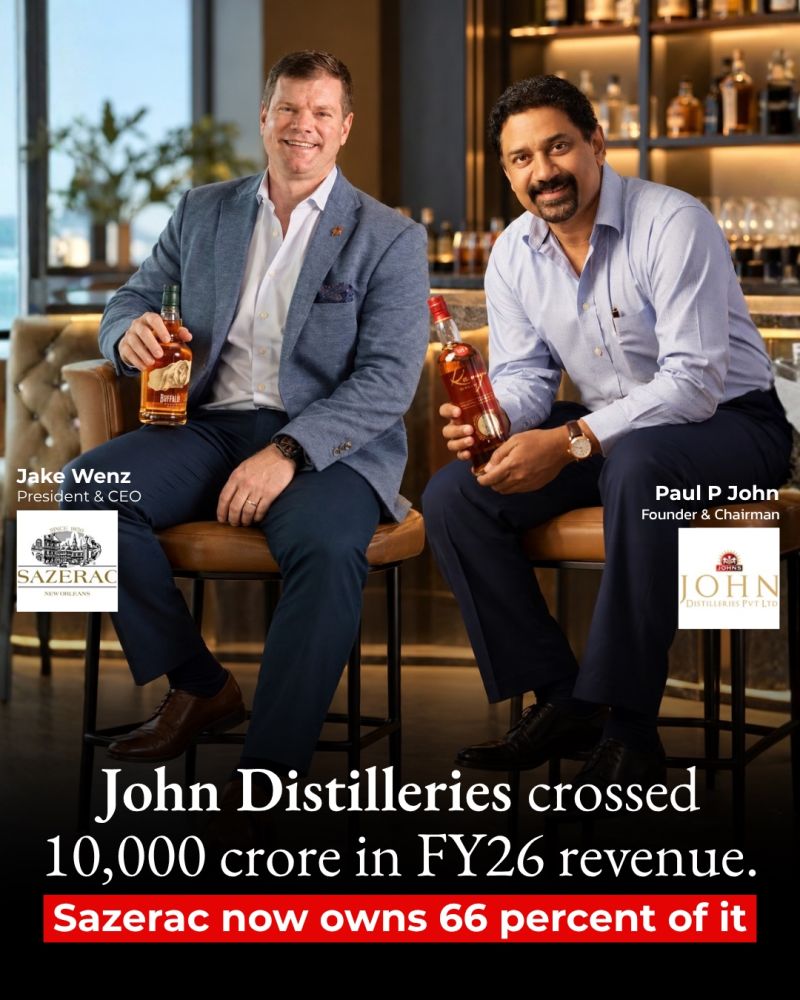
Sazerac, which now owns a majority 60 per cent stake in John Distilleries, makers of famous Paul John Whisky, said its relationship with home-grown spirits makers is a ‘productive’ one, which allows us to tap into local market expertise, route to market and production capabilities.
When asked about plans for Paul John Single Malt Whiskey, Bianchi said it is available in 44 global markets, including the US, Canada, Germany, France, the UAE, Australia and the UK.
“With Paul John Single Malt, we are telling the story of Indian craftsmanship as well as our award-winning portfolio,” he said.





Leave A Comment